Choosing the right Service Machine can influence daily efficiency, customer satisfaction, and long-term operating costs. The best choice depends on your business model, service volume, workspace, and staff capabilities. A compact machine may suit a quiet café, while a high-capacity model may better serve a busy hotel or retail counter. Real operating conditions matter more than impressive brochures.
Start by examining how the machine will be used each day. Measure peak demand, available floor space, power access, cleaning requirements, and average service time. A useful Service Machine should feel intuitive during a crowded afternoon, not only during a quiet demonstration. Check its controls, noise level, safety features, warranty terms, and maintenance support. Ask suppliers for clear performance data and references from businesses with similar workloads. Experience from comparable users often reveals weaknesses that specifications hide.
Cost deserves careful attention. The purchase price is only one part of ownership. Consumables, repairs, energy use, software fees, training, and downtime can change the final calculation. Perfect choices are rare. Your original assumptions may be wrong. Review them with actual sales data whenever possible. A reliable decision combines expert advice, hands-on testing, and realistic financial planning. Choose a machine that your team can operate confidently and maintain consistently. The most advanced option is not always the most suitable one. Sometimes, dependable simplicity wins.
Before choosing a service machine, define the work your business must complete each day. Record service volume, operating hours, workspace limits, and customer expectations. A busy café may need rapid output, while a repair shop may prioritize precision and flexible settings. Do not rely on guesswork. Review three months of orders, then identify your busiest periods.
Translate those needs into measurable requirements. Check capacity, duty cycle, power use, noise level, cleaning demands, and operator training. Measure peak demand rather than average demand. Small details matter. A machine that fits the floor may still slow staff if its controls are confusing. Ask employees to describe common delays and repeated tasks. Their experience can reveal problems that sales materials often overlook.
Reliability also depends on maintenance access, spare parts, safety features, and technical support. Request documented testing results and clear service terms before making a purchase. Run a short trial with real materials, real staff, and realistic workloads. Test before committing. My early cost estimates were too optimistic because I ignored training time and occasional downtime. Build those costs into the evaluation. Recheck the requirements every few months, because customer demand and staffing conditions rarely stay unchanged.
Choosing a service machine starts with its daily job, not its appearance. Manual machines suit low-volume work and offer simple training. Semi-automated models improve consistency while preserving operator control. Fully automated systems support repetitive, high-volume tasks, but they require stronger maintenance skills and reliable connectivity.
Compare capabilities against real operating conditions. Measure output per hour, changeover time, energy use, footprint, noise, and cleaning requirements. A busy café may need rapid heating and easy sanitation. A repair workshop may value torque control, diagnostic sensors, and durable components. The International Federation of Robotics reported 541,302 industrial robots installed worldwide in 2023, showing how strongly businesses value repeatable automation. Yet automation is not always the right answer. Underused equipment becomes an expensive metal cabinet.
Features deserve practical testing. Check whether the interface is clear under pressure, whether parts can be replaced locally, and whether usage data can export into existing systems. Deloitte’s 2024 Smart Manufacturing survey found that 86% of manufacturers expect smart manufacturing to become a key competitiveness factor within five years. That does not mean every machine needs advanced software. Start with useful data, such as downtime, cycle counts, and error frequency. Fancy dashboards can distract from a clogged filter.
Ask suppliers for a live demonstration using your materials, staff workflow, and peak demand. Record service response times and total ownership costs for at least three years. Industry reports provide direction, not certainty. Your floor, people, and customers remain the harder test.
A practical comparison of common self-service and service-automation machine types.
| Machine Type | Best Business Applications | Typical Throughput / Capacity | Typical Footprint | Power Requirements | Core Features | Staffing Impact | Main Advantages | Main Limitations |
|---|---|---|---|---|---|---|---|---|
| Self-Service Kiosk | Restaurants, clinics, retail stores, ticketing, check-in, and customer-service points | Usually 1 customer interaction at a time; transaction times commonly range from 30 seconds to 3 minutes | Approximately 0.5–1.5 m², depending on countertop or floor-standing design | Typically 100–240 V AC; commonly 50–300 W for display and computing hardware | Touchscreen interface, barcode or QR scanning, receipt printing, payment integration, accessibility options, remote software management | Reduces routine order-taking, registration, and payment tasks; staff are still needed for exceptions and support | Shorter queues, consistent workflows, improved data capture, and flexible operating hours | Requires reliable connectivity, regular software updates, and a user-friendly interface |
| Product Vending Machine | Snacks, beverages, personal-care products, electronics accessories, and workplace supplies | Approximately 20–60 product selections; often supports dozens to several hundred units depending on product size | Typically 0.8–1.2 m wide, 0.8–1.0 m deep, and 1.8–2.0 m high | Usually 100–240 V AC; refrigerated models commonly use about 1–4 kWh per day, depending on climate and usage | Cashless payment, inventory sensors, temperature control, product spirals or lifts, telemetry, security locks | Low daily staffing requirement; regular replenishment, cleaning, and technical checks are still necessary | 24/7 sales potential, compact retail footprint, and easy placement in high-traffic locations | Limited product size and range; sales depend heavily on location, stock availability, and payment uptime |
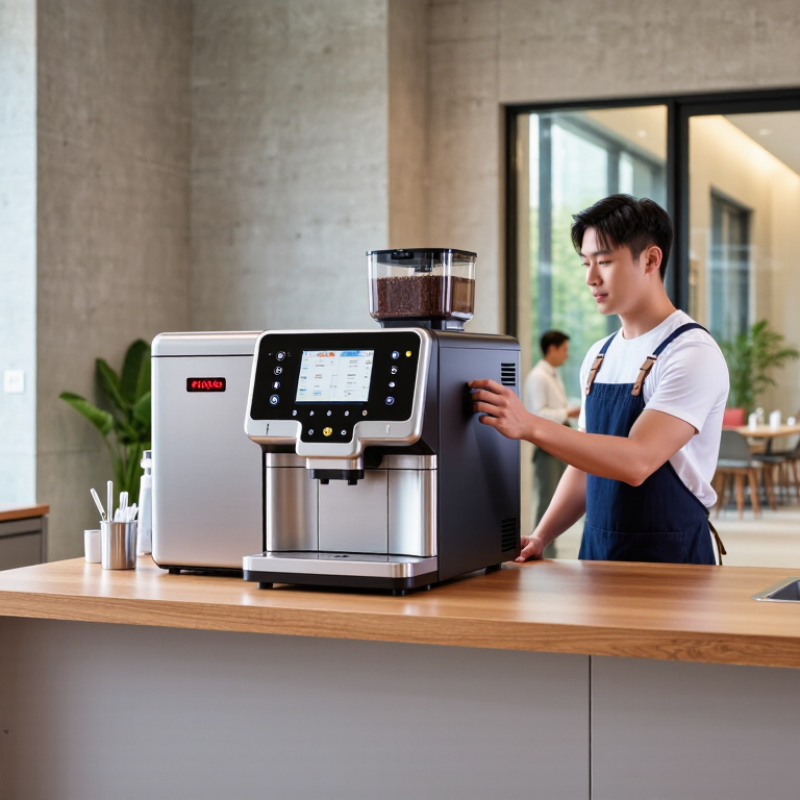
| Commercial Coffee Machine | Hotels, offices, cafés, restaurants, waiting areas, and hospitality facilities | Approximately 30–200 beverages per hour, depending on brewing method, menu complexity, and operator workflow | Countertop units commonly require 0.3–0.8 m²; larger models may require dedicated service clearance | Commonly 1.5–6 kW; many high-output units require a dedicated electrical circuit and water connection | Programmable recipes, grinder, automatic milk system, boiler or thermoblock heating, cup sensors, cleaning cycles | Can reduce manual preparation for standard drinks; replenishment, cleaning, and quality control remain important | Consistent portions, faster service, menu customization, and improved beverage availability | High-use models require frequent cleaning, descaling, ingredient replenishment, and preventive maintenance |
| Commercial Laundry Machine | Hotels, laundromats, residential buildings, gyms, care facilities, and uniform-service operations | Washer capacities commonly range from 8–25 kg per load; cycle times are often 25–60 minutes | Individual units commonly occupy about 0.7–1.2 m², excluding circulation and service space | Electric heating commonly ranges from 3–15 kW; water, drainage, ventilation, and sometimes gas connections are required | Programmable cycles, high-spin extraction, automatic dosing, payment controls, water-level management, fault diagnostics | Automates washing and drying but still requires loading, unloading, sorting, cleaning, and maintenance | High volume processing, repeatable results, durable construction, and potential self-service revenue | Significant water and energy consumption; installation may require structural, plumbing, and ventilation work |
| Floor Scrubber-Dryer | Retail facilities, warehouses, hospitals, schools, airports, and large commercial buildings | Cleaning width commonly ranges from 400–850 mm; practical productivity is approximately 1,000–4,000 m² per hour | Walk-behind models generally require 0.6–1.2 m² of storage area; ride-on models require more space | Battery-powered models commonly use 24–36 V systems; operating time is often 2–5 hours per charge | Rotating brushes or pads, solution tank, recovery tank, vacuum squeegee, adjustable pressure, battery monitoring | Reduces manual mopping and drying time; trained operators are required for safe and effective use | Improves cleaning consistency, covers large areas efficiently, and reduces wet-floor exposure time | Not suitable for stairs or heavily obstructed areas; batteries, brushes, squeegees, and tanks need routine care |
| Parcel Locker System | Residential buildings, offices, retail pickup points, campuses, logistics hubs, and secure returns services | Common configurations provide approximately 20–100 compartments in one modular installation | A modular bank commonly requires 1–4 m², depending on compartment count and layout | Typically 100–240 V AC; basic electronic locker systems generally use low continuous power | Electronic locks, PIN or QR access, touchscreen or keypad, delivery notifications, audit trail, modular compartments | Reduces counter-service handling and repeated delivery attempts; staff manage exceptions and compartment maintenance | Secure unattended collection, improved delivery flexibility, and reduced queue pressure | Compartment sizes limit package dimensions; requires secure placement, network availability, and user support procedures |
Choosing a service machine should begin with total cost, not the purchase price. The U.S. Department of Energy reports that stronger operations and maintenance practices can reduce energy use by 5% to 20%. That saving matters when a machine runs eight hours daily under heavy demand. Calculate energy, labor, spare parts, software, training, and disposal costs over five years. A cheap machine may become expensive after repeated repairs.
Measure practical efficiency at the worksite. Record output per hour, setup time, cleaning time, and unplanned downtime. The U.S. Department of Energy identifies predictive maintenance as a way to reduce breakdowns and improve equipment availability. Still, sensors do not solve poor procedures. Someone must review the readings and act quickly. That human step is easy to underestimate.
Long-term value also depends on service access and upgrade flexibility. Ask for documented maintenance intervals, parts availability, warranty conditions, and technician response times. The International Facility Management Association has repeatedly highlighted maintenance planning as a major factor in asset performance. A useful machine should fit your workflow, not force employees into awkward routines. Test one unit during a busy week, if possible. Our first estimate may be wrong. A spreadsheet can miss noise, heat, operator fatigue, and the ten-minute delay that happens every afternoon.
Evaluate acquisition cost, operating efficiency, and long-term ownership value across common commercial machine categories.
These representative planning estimates compare typical equipment ranges. Higher automation requires more upfront investment, but it can deliver greater throughput and lower cost per service over time. Confirm capacity, maintenance requirements, labor savings, and supplier quotations before making a purchase decision.
Compatibility should be tested before purchase, not after installation. Measure floor space, voltage, airflow, load limits, and connection types. A machine may fit physically but still fail operationally. Check software requirements and integration with existing control systems. Ask technicians to inspect a sample unit under real working conditions. Small mismatches can create expensive delays.
Compatibility should be tested before purchase, not after installation.
Support is part of the machine. Confirm response times, training, remote diagnostics, spare-part availability, and technician coverage.
The U.S. Department of Energy’s Operations and Maintenance Best Practices Guide reports that predictive maintenance can reduce maintenance costs by 25% to 30% and downtime by 35% to 45%.
Those figures depend on accurate monitoring and disciplined follow-up. Maintenance needs should also shape the purchase decision. Review cleaning points, filter access, lubrication schedules, calibration steps, and expected service intervals. Keep a written maintenance log from day one. The details matter.
I have seen teams focus too heavily on purchase price. That is a costly habit. A cheaper machine may require specialist tools, longer repairs, or unavailable parts. Ask for a five-year maintenance estimate, not just a quotation.
The International Facility Management Association’s maintenance benchmarking research also shows that planned maintenance supports more predictable operating costs. The data is useful, but not perfect. Your workload, operators, and site conditions may produce different results. Test the machine before committing.
Ask for a five-year maintenance estimate, not just a quotation.
Selecting a service machine starts with the work, not the brochure. Map daily demand, peak hours, operator skill, available space, and maintenance access. A busy counter may need fast output, while a small office may value quiet operation. Measure the queue. Talk with the people who will use the machine every day. Their practical experience often exposes awkward controls, cleaning delays, or hidden safety risks.
Compare machines using a simple scorecard: capacity, setup time, energy use, training needs, service response, and total ownership cost. Ask suppliers for performance data under conditions similar to yours. Request a demonstration with your actual materials and busiest workflow. Our first estimate was wrong. A machine that looked efficient slowed staff during changeovers. That mistake showed why advertised speed needs real workplace testing. Check documentation, warranty terms, inspection requirements, and spare-part availability before signing.
Implement the selected machine through a controlled pilot. Assign one trained owner, then record output, errors, cleaning time, and user feedback for two weeks. Post clear operating steps nearby, and keep emergency instructions easy to find. Train more than one person, because absence can stop the process. Review the results with operators, not only managers. If downtime repeats, adjust staffing or reconsider the machine before full deployment. Keep a dated log of every adjustment, repair, and training session.